Education Centre
The Science of Sciatica: Why Your Leg Hurts When Your Back Is the Problem
Sciatica affects 40% of people at some point in their lives, yet it remains widely misunderstood. Many patients treat the symptom — leg pain — without addressing the spinal compression causing it.
40%
Adults affected by sciatica
90%
Cases resolve with proper treatment
L4-S1
Most affected spinal levels
2-4 wk
Average recovery with decompression
What Is Sciatica?
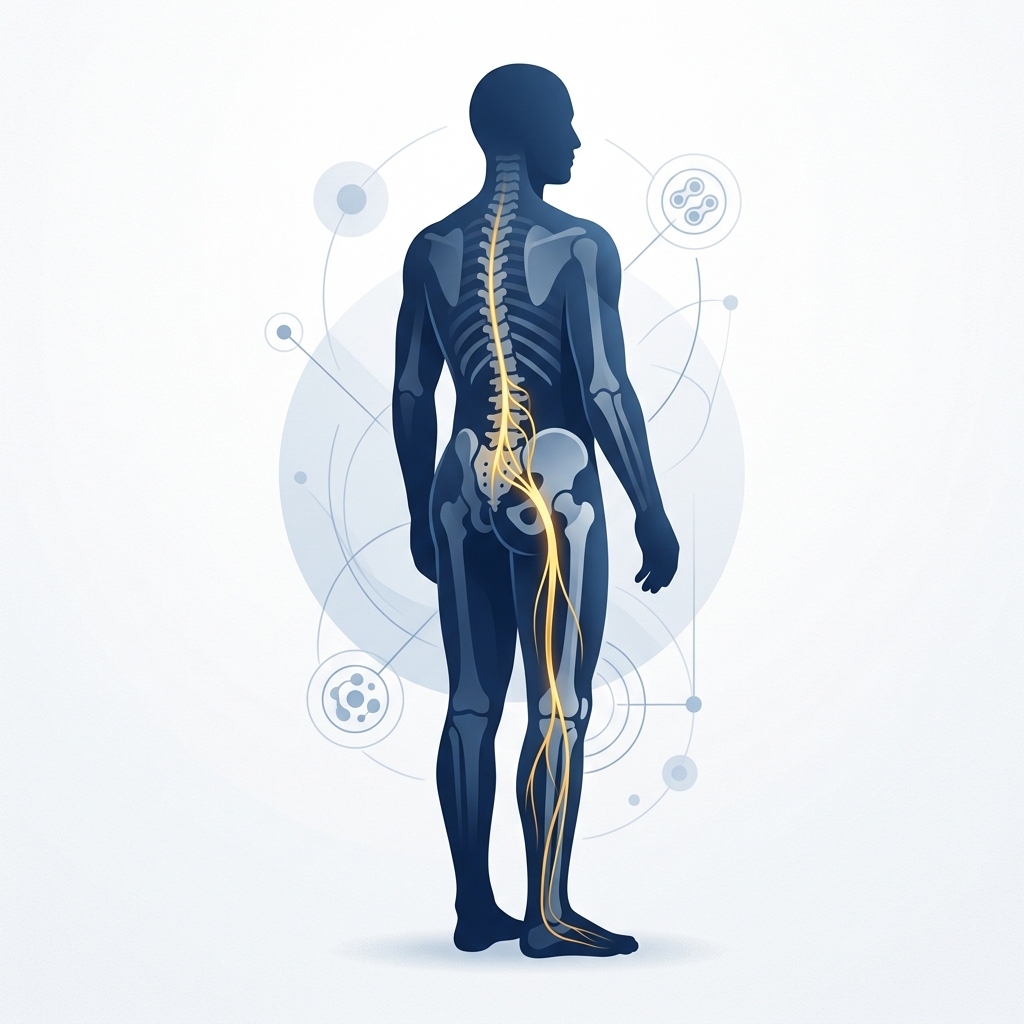
Sciatica is not a diagnosis — it's a symptom. The term describes pain, tingling, or numbness that travels along the path of the sciatic nerve, which runs from your lower back through your hips, buttocks, and down each leg.
The pain originates in your spine, specifically when something compresses the sciatic nerve roots at lumbar levels L4 to S1. Understanding this distinction is crucial: treating only the leg where you feel pain ignores the spinal source of the problem.
The 3 Root Causes of Sciatica
Herniated Disc (Most Common)
When the soft centre of a spinal disc bulges out and presses against sciatic nerve roots. Often triggered by sudden movements, heavy lifting, or prolonged poor posture.
Lumbar Spinal Stenosis
Narrowing of the spinal canal, often due to age-related bone spurs or thickened ligaments, which compresses the nerve roots.
Piriformis Syndrome
Spasm or tightening of the piriformis muscle in the buttock, which sits directly over the sciatic nerve. Often misdiagnosed as disc herniation.
Evidence-Based Treatments
The most effective treatments address the underlying spinal compression rather than just managing pain:
- Lumbar decompression — traction-based relief that creates space between vertebrae
- Targeted physiotherapy — McKenzie method and nerve mobilisation exercises
- Anti-inflammatory protocols — reducing disc swelling naturally
- Postural correction — eliminating the daily habits perpetuating the compression

Recommended for Sciatica Relief
Clinically designed lumbar support to help relieve sciatic nerve compression at L4–S1.