Stärke aufbauen. Besser bewegen. Weiterspielen.
Pickleball ist eine unterhaltsame Möglichkeit, aktiv zu bleiben, wenn Sie älter werden - aber das Spiel trainiert nicht jede körperliche Qualität, die Ihr Körper braucht.
Eine einfache Kombination auskraft, Gleichgewicht, Beweglichkeit und kontrollierte Bewegungkönnen Ihre Zeit auf dem Platz ergänzen und Ihnen helfen, auf die Bewegungsanforderungen von Pickleball vorbereitet zu bleiben.
Muscle-Strengthening Activity Each Week
Adults should include muscle-strengthening activity on at least 2 days each week, working the major muscle groups.
Moderate Aerobic Activity Each Week
Adults should aim for at least 150 minutes of moderate-intensity aerobic activity each week, or an equivalent combination of moderate and vigorous activity.
Aerobic • Strength • Balance
For adults 65+, current CDC guidance recommends a combination of aerobic activity, muscle-strengthening activity, and balance activities each week.
MERKMALE
Wenn Sie Pickleball von der Seitenlinie aus beobachtet haben, kann es täuschend einfach aussehen.
Sobald du spielst, nimmt dein Körper jedoch ständig kleine Anpassungen vor.
Du trittst seitwärts, um einen Schuss zu erreichen.
Du beugst dich und erholst dich.
Du drehst deinen Kofferraum.
Sie erreichen mit Ihrem Paddel.
Du stößt einen Fuß ab.
Du verlangsamst und änderst die Richtung.
dann sei mal lieber auf der Hut.
Deswegen...pickleball-Übungen für Senioren und ältere Erwachsene sollten mehr als nur die Herzfrequenz erhöhen.
Eine abgerundete Übungsroutine kann Ihre Zeit auf dem Platz ergänzen, indem Sie Folgendes entwickeln:
- Unterkörperkraft
- Hüft- und Rumpfbeweglichkeit
- Gleichgewicht und Körperkontrolle
- Unauffällige Bewegung im System
- Kern- und Haltungsausdauer
- Oberkörperkraft
- Aerobic-Fitness
Du musst nicht wie ein Profisportler trainieren.
The goal is simpler:
Build a body that is prepared for the way you want to move.
And pickleball itself can be a meaningful part of that plan.
A 2026 randomized controlled trial followed 72 community-dwelling older adults with pre-frailty. After an 8-week supervised pickleball program, the participants showed improvements in several measures of functional fitness, including chair-stand performance, arm-curl strength, flexibility, and six-minute walking distance. Physical and mental quality-of-life measures also improved.
The important takeaway isn't that pickleball replaces exercise training.
It's that pickleball can be an enjoyable form of physical activity—and supplemental strength, balance, and mobility work can help create a more complete fitness routine.
-
WHY PICKLEBALL REQUIRES MORE THAN CARDIO
1. Pickleball Is a Stop-and-Go Sport
Pickleball isn't a steady walking activity.
You repeatedly accelerate, decelerate, change direction, and reposition yourself.
That means your legs need to produce force—and then control your body as you slow down.
Train for it:sit-to-stands, step-ups, controlled lateral steps, and supported split-stance exercises.
2. Your Legs and Hips Do Much of the Work
Every shot begins with your relationship to the ground.
Your feet, ankles, calves, knees, and hips help you move into position and recover afterward.
Lower-extremity injuries are an important concern in pickleball research. A 2026 systematic review of 15 studies found that sprains, strains, and fractures were among the most commonly reported lower-extremity injuries. Falls and forward running or lunging were important injury mechanisms, and age 50+ was a consistent risk factor across the studies reviewed.
This doesnotmean pickleball is unsafe.
It means that maintaining lower-body strength, balance, and movement control is worth prioritizing.
3. Balance Becomes Part of Every Shot
A good pickleball player doesn't simply move toward the ball.
They move toward it while staying organized enough to hit the ball and recover.
That requires balance and body awareness.
Balance work is also specifically recommended for adults 65+ as part of their weekly physical activity.
Train for it:supported single-leg balance, controlled weight shifts, and step-and-hold drills.
4. Your Trunk Needs to Rotate and Recover
Pickleball involves repeated reaching, turning, bending, and rotational movements.
Your trunk doesn't need maximum flexibility.
It needscomfortable, controlled movement.
That is why trunk mobility and core endurance belong alongside strength and balance work.
5. Your Upper Body Still Has a Job
Your legs create the foundation, but your shoulders, upper back, arms, and hands repeatedly control the paddle.
Rows, controlled shoulder movements, and upper-back mobility can complement your time on the court.
6. Pickleball Does Not Replace Strength Training
Playing pickleball can provide meaningful physical activity, but it shouldn't be assumed to train every major muscle group adequately.
The CDC recommends that adults 65+ combine aerobic activity with muscle-strengthening activity at least 2 days per week and include balance activities.
Think of your training as a team:
Pickleball + strength + balance + mobility + recovery.
8 PICKLEBALL EXERCISES FOR ADULTS 50+
These exercises are designed for generally healthy adults who want to complement their pickleball activity.
You don't need to perform all eight in every session.
Start with movements you can perform comfortably and with good control. Progress gradually as your fitness improves.
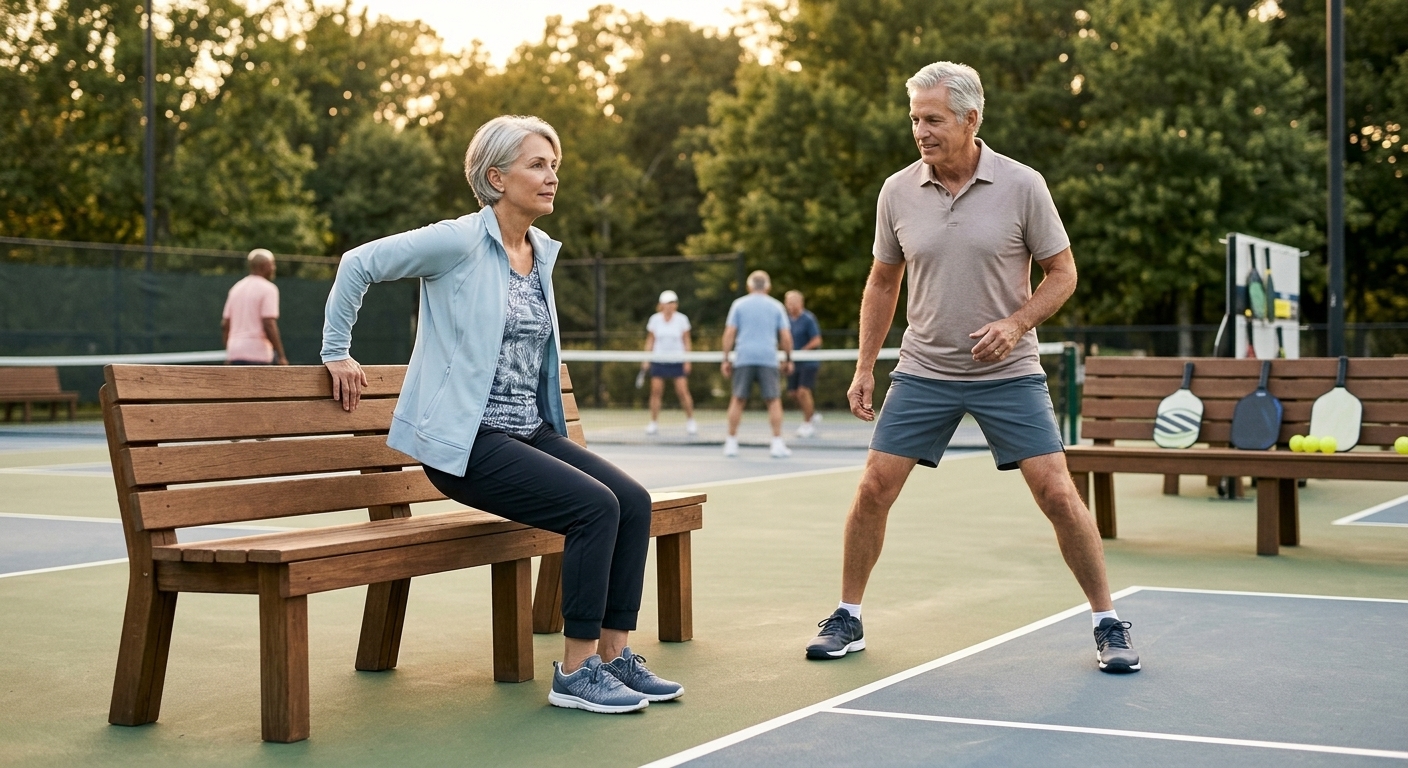
1. Sit-to-Stand
What it trains:
Thighs, hips, and functional lower-body strength.
How to do it
- Sit toward the front of a sturdy chair.
- Place your feet approximately hip-width apart.
- Lean your torso slightly forward.
- Press through your feet to stand.
- Slowly lower yourself back toward the chair.
- Repeat with control.
Starting point:8–12 repetitions.
Make it easier:Use your hands on the chair or another stable support as needed.
Why it matters for pickleball:
Strong legs help you repeatedly lower, rise, and reposition during play.
2. Supported Calf Raises
What it trains:
Calf and ankle strength.
How to do it
- Stand behind a sturdy chair or near a stable counter.
- Lightly hold the support.
- Rise onto the balls of your feet.
- Pause briefly.
- Lower slowly.
Starting point:8–15 repetitions.
Why it matters for pickleball:
Your calves and ankles contribute to pushing off and controlling movement around the court.
3. Lateral Step and Return
What it trains:
Side-to-side movement, hip strength, and movement control.
How to do it
- Stand tall with your feet about hip-width apart.
- Take a small step to the right.
- Bring your left foot toward your right.
- Repeat to the left.
- Keep the movement controlled rather than rushing.
Starting point:8–10 steps in each direction.
Progression:Gradually increase the step distance while maintaining control.
Why it matters for pickleball:
Court movement frequently requires side-to-side repositioning.
4. Supported Single-Leg Balance
What it trains:
Balance, ankle control, and body awareness.
How to do it
- Stand next to a sturdy counter or chair.
- Keep one hand available for support.
- Shift your weight onto one leg.
- Lift the opposite foot slightly from the floor.
- Hold briefly.
- Lower the foot and switch sides.
Starting point:10–20 seconds per side.
Important:Keep the support close.
This is a balance exercise—not a test of how long you can stand unsupported.
Why it matters for pickleball:
Your body often needs to remain controlled while your weight shifts onto one leg.
5. Unterstütztes Hüftgelenk
What it trains:
Hip strength, posterior-chain coordination, and controlled bending mechanics.
How to do it
- Stand with your feet about hip-width apart.
- Place your hands lightly on your thighs or use a stable support.
- Keep your spine comfortable and controlled.
- Push your hips backward.
- Allow your torso to lean forward naturally.
- Press through your feet and return to standing.
Starting point:8–12 repetitions.
Why it matters for pickleball:
The hip hinge helps you use your hips while controlling your trunk during bending movements.
6. Standing Trunk Rotation
What it trains:
Controlled trunk mobility and rotational coordination.
How to do it
- Stand comfortably with your feet slightly wider than hip-width.
- Bend your elbows or extend your arms comfortably.
- Slowly rotate your trunk to one side.
- Return to center.
- Rotate to the other side.
- Keep the movement smooth and within a comfortable range.
Starting point:6–8 controlled repetitions per side.
Important:This is controlled mobility—not a forceful stretch.
Why it matters for pickleball:
Pickleball involves repeated turning and reaching.
7. Resistance-Band Row
What it trains:
Upper-back, shoulder, and postural strength.
How to do it
- Secure a resistance band to an appropriate, stable anchor.
- Hold the band with your arms extended.
- Pull your elbows backward.
- Gently draw your shoulder blades toward one another.
- Return slowly.
Starting point:8–12 repetitions.
Why it matters for pickleball:
A stronger upper back can complement the repeated reaching and paddle movements involved in play.
Safety note:Only use an anchor point that is specifically designed and secure for resistance-band exercise.
8. Step-Up
What it trains:
Lower-body strength, balance, and single-leg control.
How to do it
- Use a low, stable step.
- Hold a nearby rail or sturdy support if needed.
- Place one foot fully on the step.
- Press through that leg to step up.
- Step down slowly and with control.
- Alternate sides.
Starting point:6–10 repetitions per side.
Important:Use a lower step if necessary. Quality of movement matters more than height.
Why it matters for pickleball:
Step-ups challenge your ability to produce and control force through one leg.
A SIMPLE WEEKLY PICKLEBALL FITNESS PLAN
You don't need a complicated training schedule.
The goal is to give your body a variety of movement challenges rather than expecting pickleball to do everything.
Example Week
Monday — Strength + Balance
- Sit-to-stand
- Supported hip hinge
- Wadenheben
- Widerstandsbandreihen
- Supported single-leg balance
Tuesday — Pickleball
- Dynamic warm-up
- Pickleball
- Gentle recovery afterward
Wednesday — Mobility + Walking
- Trunk rotations
- Hip mobility
- Shoulder mobility
- 20–30 minute walk
Thursday — Strength + Balance
- Step-Ups:
- Sit-to-stands
- Lateral steps
- Wadenheben
- Balance practice
Friday — Pickleball
- Dynamic warm-up
- Pickleball
- Recovery routine
Saturday — Optional Activity
- Walking
- Mobility
- Light recreational activity
- Easy pickleball if you feel recovered
Sunday — Recovery
- Gentle movement
- Walking
- Mobility
- Rest as needed
This is an example—not a prescription.
For adults 65+, the CDC recommends at least 150 minutes of moderate aerobic activity per week, muscle-strengthening activity on at least 2 days, and balance activities. Activity can be spread throughout the week and adjusted according to individual abilities and health circumstances.
For adults 50–64, the general adult guidelines include at least 150 minutes of moderate aerobic activity and muscle-strengthening activity on at least 2 days each week.
BEFORE PICKLEBALL: WARM UP
Before playing, prioritize dynamic movement rather than spending a long time holding static stretches.
A 5–10 minute warm-up can include:
- Easy walking or marching
- Shoulder circles
- Arm swings
- Hip circles
- Leg swings
- Mini squats
- Gentle trunk rotations
- Controlled side steps
- Gradually increasing pickleball movements
The goal is to gradually move from easy activity toward the movements you will use on the court.
For a complete routine, see our Pickleball-Aufwärmübungen.
AFTER PICKLEBALL: RECOVER AND MOVE GENTLY
After playing, give your body time to gradually transition out of activity.
A short walk followed by gentle mobility or comfortable stretching can be a useful way to wind down.
Our Pickleball Dehnübungen guide provides a separate flexibility routine you can use after playing or on a non-playing day.
A simple rule:
Dynamic movement before play.
Gentle flexibility and mobility after play or during a separate session.
YOU DON'T NEED TO TRAIN LIKE A PROFESSIONAL ATHLETE
One of the easiest mistakes to make when starting a new exercise routine is doing too much too soon.
You don't need:
- Heavy weights
- Deep squats
- High-intensity jumping
- Long workouts
- Extreme flexibility
- Difficult balance drills
You need exercises you can performconsistently and with control.
Start with a manageable level.
Then gradually increase repetitions, resistance, range of motion, or duration as your body adapts.
TRAIN MOVEMENT QUALITY, NOT JUST MUSCLE
Pickleball isn't simply about having strong muscles.
It's about coordinating them.
A useful exercise program therefore combines:
Strength
Can you produce force?
Balance
Can you control your body while your weight shifts?
Mobility
Can you comfortably access the positions you need?
Coordination
Can you put those abilities together?
Endurance
Can you keep moving as the game continues?
This is why a well-rounded program can be more useful than focusing on only one type of exercise.
YOUR BEST RANGE OF MOTION IS THE RANGE YOU CAN CONTROL
More flexibility isn't automatically better.
For pickleball, the goal is to move comfortably through the ranges you use—and control those positions.
Don't force a stretch or push into painful range.
Instead:
Move comfortably.
Move gradually.
Move with control.
If you're interested specifically in flexibility work, see our Pickleball DehnübungenLeitfaden.
BALANCE TRAINING DESERVES A PLACE IN YOUR ROUTINE
Balance is a physical skill that can be practiced.
Simple options include:
- Gestütztes einbeiniges Stehen
- Kontrollierte Gewichtsverlagerungen
- Step-and-Hold-Übungen
- Gehen von Ferse bis Ferse
- Sit-to-stand movements
Always practice challenging balance exercises near a stable support.
For adults 65+, balance activities are specifically included in the CDC's weekly physical activity recommendations.
WHAT ABOUT YOUR CORE AND LOWER BACK?
Pickleball involves bending, reaching, rotation, and repeated changes in position.
That doesn't mean you need to avoid those movements.
Instead, the goal is to develop the ability to perform them comfortably and with control.
A balanced exercise program can include:
- Hip strength
- Trunk mobility
- Core endurance
- Unterkörperkraft
- Movement coordination
- Appropriate recovery
The 2026 evidence on pickleball injuries also reinforces the importance of considering lower-body movement, balance, and controlled direction changes when thinking about fitness for older players.
PICKLEBALL IS ONLY ONE PART OF YOUR ACTIVE LIFESTYLE
One of the best things about pickleball is that physical activity doesn't have to feel like a workout.
You move.
You react.
You socialize.
You learn.
You compete—or don't.
And you have a reason to keep showing up.
The recent randomized trial in older adults adds to the growing evidence that structured pickleball can improve functional fitness and quality of life.
But you don't have to rely on pickleball alone.
Walking, strength training, mobility work, balance exercises, gardening, cycling, swimming, and other activities can all contribute to an active lifestyle.
The best routine is one that fits your abilities—and that you enjoy enough to continue.
A BETTER WAY TO THINK ABOUT PICKLEBALL FITNESS
You don't have to choose betweenplaying pickleballandexercising.
Let them support each other.
Play pickleball for movement, enjoyment, and connection.
Strength train to build your physical foundation.
Practice balance to develop body control.
Work on mobility to maintain comfortable movement.
Recover so you're ready for your next session.
That combination creates a more complete approach to staying active as you get older.
DAINELY: SUPPORT FOR ACTIVE MOVEMENT
Dainely Belt — Support for Active Movement
The Dainely Belt is designed for adults who want comfortable support while staying active through everyday movement, recreation, golf, pickleball, walking, travel, and other activities.
It is designed to complement an active lifestyle—not replace exercise, strength training, or professional care.
Keep moving. Keep playing. Keep doing what you love.
Daily Support & Recovery System — A Practical Movement Routine
The Daily Support & Recovery System combines the Dainely Belt and Extender with practical movement and recovery resources designed around active adults.
The included resources cover:
- Rotational stability
- Post-play recovery
- Pre-activity movement preparation
It's designed to make movement preparation and recovery easier to incorporate into everyday life.
Ergo Cushion — Comfort Between Games
If you spend significant time sitting between games, while traveling, or at home, the Ergo Cushion provides another way to make everyday sitting more comfortable.
SAFETY & MEDICAL DISCLAIMER
This article is provided for general educational and wellness purposes only. The exercises described are not intended to diagnose, treat, cure, or prevent any medical condition or injury.
Exercise selection and intensity should be appropriate for your individual fitness level and abilities.
Stop an exercise if you experience sharp or worsening pain, dizziness, chest discomfort, unusual shortness of breath, numbness, tingling, or other concerning symptoms.
If you have an injury, significant mobility or balance limitations, cardiovascular or other medical conditions, or have been inactive for an extended period, consult an appropriate healthcare professional before beginning or substantially changing an exercise program.
When in doubt, work with a qualified physical therapist or other healthcare professional who can assess your individual needs and help you modify exercises appropriately.
FINAL TAKEAWAY
You don't need to train harder just to keep playing pickleball.
Train smarter.
Build your legs.
Challenge your balance.
Move your hips and trunk.
Strengthen your upper body.
Practice controlled movement.
And give your body time to recover.
Because staying active isn't just about playing the next game.
It's about being ready for the next game—and the one after that.
Stärke aufbauen. Besser bewegen. Weiterspielen.
Für Sie empfohlen


